
This September, on a trail in Colorado, I saw a mud bog and decided to show off to my riding buddy by blasting through it on my Suzuki DR650. The mud was deeper and stickier than it looked. I lost all my momentum halfway through the bog and, with great embarrassment, dropped the bike. I immediately cut the engine and levered the motorcycle back upright. I hit the ignition and all I heard was the “chck…chck…chck” of the starter motor. The engine was flooded.
What was worse was that there was no way for me to pull the bike out on my own. My pal very graciously agreed to fill his boots with mud to help me haul it onto the dry bankside. A good friend.
Next to the bog, I opened up my trail toolkit and removed the bike’s side panels and seat to give me access to the airbox. Upon opening the airbox lid, I was greeted with a deluge of muddy water. Not good. Water was almost certainly in the engine.
To get the rest of the water out, I tipped the bike on its side. I then removed the air filter, wrung it out, and cleaned the inside of the airbox as best as I could with my riding jersey. To evacuate the water that had made it into the cylinder bore, I removed the gas tank and spark plugs and ran the starter again to drive the piston. Water spouted out of the plug holes like Free Willy breaking the surface.
All that was left to do was button the bike back together and, with a prayer, try to start her up. After priming the carb and applying a touch of choke, the bike fired into life, with steam pulsing out of the exhaust as any remaining water was vaporized by each ignition cycle. We were stopped for maybe 25 minutes, and every tool I needed to complete the fix was contained in my little tool pouch.

The two bikes post-bog. You can see that one is considerably muddier than the other!
The DR650 is my favorite thing I own. It’s been my companion on a lot of my best adventures, and it’s connected me with people as passionate about motorcycles as I am. But the thing I love most is that it’s a teacher.
A drowned engine in the middle of the trail is, for many people and many bikes, the end of the ride (and possibly the start of a terrible recovery ordeal). On the DR it’s a 25-minute job that I learned by watching one of the thousands of videos other DR owners have made.
The DR is a simple machine, and it has been the same for a long time. The current design dates back to 1996, which makes it only a year younger than me. It comes with an air-cooled, 644cc single-cylinder engine. Fuel and air are delivered through a 40mm Mikuni carburetor. It has no ABS or traction control. It is probably the simplest full-size motorcycle currently available, and sells new in the US for $7,299.
It is best at nothing. The suspension bottoms out as soon as you start pushing the pace on trails and the lack of wind protection and stiff seat make extended highway riding uncomfortable.
For now though, the soft suspension is just another lesson that the DR offers. It makes me pick my lines more carefully and rely on improving my skills to keep up with friends on more complex, more modern machines. Better parts and more electronics from stock would have covered for me, and I would have learned less.
My riding is now close to truly outgrowing the stock suspension, and when it does, I’ll upgrade. That probably means stiffer fork springs and a set of cartridge emulators. Maybe a new rear shock. Fitting those parts will offer me a deeper understanding of the bike’s suspension system, further reinforcing my riding skills and connection to the bike.
The bike and I have grown together, and that is the connection I feel to it. I know what it will do, and I know what to do when it doesn’t.
Worse on Purpose investigates why the things you buy are getting worse. Subscribe to get the next essay in your inbox.
What it teaches
For a machine to be easily learned, three things must be true:
Its systems are easily accessible.
Service mistakes are cheap to remedy and do not cause catastrophic failure.
A wealth of information on the machine and its maintenance procedures is freely available.
Each is true for the DR650.
Excluding internal engine components, virtually every system on the bike can be accessed by simply removing the side panels, the seat and the tank. That takes no more than 5 minutes.

The DR650 in service mode the day I bought it.
In the bog, water ran from the airbox into the cylinder. Every step on that path was within reach with tools from my lightweight trail kit. No electronics to speak of. If something does go wrong, replacement parts are incredibly cheap. In another misadventure, I rammed the bike into a boulder and cracked my stator cover, leaking oil everywhere. I managed to close up the hole with JB Weld and keep riding. When I got home, I ordered a replacement cover for $120.
The rest of my teachers were other owners. The main DR650 thread on ADVrider was started in May 2006 and now runs past 11,700 pages. Between the other forums and the YouTube channels, I have yet to find a job on the bike that someone hasn’t filmed or written up.
The knowledge library is so deep because the bike has remained unchanged for so many years. Practically every part number is the same today as it was on Suzuki’s 1996 diagram. In 2016, Canada Moto Guide joked that Suzuki had just marked the “20th year of Bold New Graphics” for the DR.
The fact that little beyond the paint has changed since 1996 makes the DR650 one of the most learnable machines around.
What it taught me
Before the DR, the most I’d done on a car was change the oil and the air filter. I bought the bike in 2022, a 2019 model with only 500 miles on the odometer. In my 4 years of ownership, I’ve done almost every job it has. The list runs from oil changes and chain adjustments to valve checks and clutch plates and fork seals. Everything I did I learned from YouTube videos, forum posts and my trusty Clymer manual.
The bike hands owners these jobs in a sensible order. The ones it asks for first are the easy ones. The more difficult ones only come up rarely. By the time a hard job became necessary, the easier ones had already taught me my way around.
And the skills are transferable. Brakes are a good example. I flush and bleed the DR’s brakes regularly. I have replaced the entire system once, routing new lines on a system I could easily see end to end. After that, the same jobs on a car felt much less intimidating. A car’s brakes operate in the same way as the DR’s. The differences are a matter of scale, complexity and materials.
My other vehicle is a 5th gen 4Runner. I recently completed the major 60,000-mile service in my garage. You can see my checklist below.
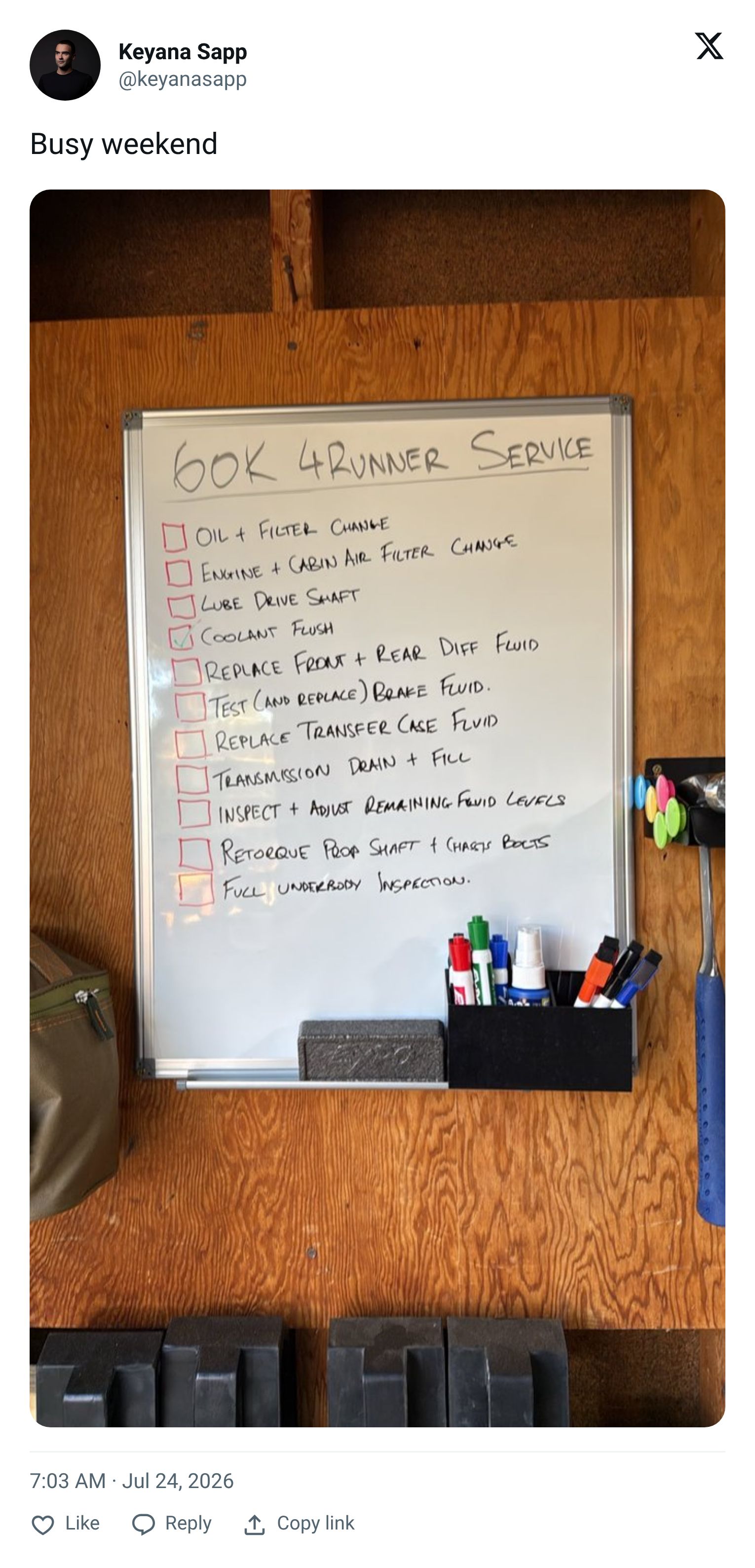
This owner was quoted $2k for the same service, and I notice a few required items were missing. I would not have felt comfortable taking on this service myself were it not for the tutelage of my DR650. It gave me the easy version of all of these tasks first.
In Zen and the Art of Motorcycle Maintenance, Robert Pirsig takes his bike to a shop where the mechanics work with the radio blaring. They miss the real fault on his bike, a sheared pin worth about 25 cents. Pirsig sees them as spectators to their own work, with no stake in the job. He blames a way of thinking that treats the mechanic and the machine as two separate things, a subject working on an object. When that split is fully accepted, he writes, “a certain nondivided relationship between the mechanic and motorcycle, a craftsmanlike feeling for the work, is destroyed.”
The DR has never let me be a spectator. In the bog, there was nobody to hand the bike to. The fault was mine alone to solve. That has given me the relationship Pirsig describes. It is a source of pleasure and meaning that is harder to find in modern machines.
Learning to judge
Developing a deeper relationship with the objects in your life does more than provide pleasure, though. It builds judgment.
Earlier this year, I wrote two essays about quality. In On Quality, I argued that quality exists in the meeting between a person and an object in use. In Between Craft and Quality, I argued that quality is only detectable by those who have developed the capability of judgment. I argued that the capability comes from practice and comparison, and that labor specialization has stripped people of both. As I put it then, you cannot assess a process you have never performed yourself.
A quality nobody can detect is a quality nobody demands. A quality nobody demands simply stops being made.
Buyers who can judge act as a kind of umpire for markets. They keep companies honest by calling out lapses in quality for all buyers. Borrowing from David Hume, I refer to these people as “competent judges” and argue that they are now in dangerously low supply.
The DR has made me a far better judge of vehicles than I was before it. The bike's innate curriculum invited me to learn each system at a manageable pace, and I was able to carry that knowledge to the more complex systems on the truck.
Four years ago, I would have paid that owner's $2k quote without a second look. When I upgrade the DR’s suspension, I’ll know what the stock parts get wrong and precisely what I’m paying to fix.
And that confidence goes beyond vehicles. I credit my work on the bike with my willingness to open up household appliances and poke around with a multimeter when things go wrong. The systems on a dishwasher aren’t that different, and the logic of tracing a fault is the same.
I ended Between Craft and Quality by asking readers whether they thought the ability to judge could be taught, and if so, by whom. My answer is yes and my teacher is the DR650, and all the owners who cared enough to share their knowledge online.
If this post was useful to you, please consider becoming a member. It’s $10 a month or $100 a year.
I take no money from the brands I write about. There are no affiliate links, and no brand can pay for coverage. That way, the only people I answer to are readers.
If subscriptions aren’t your thing, you can also support with a one-time donation of any amount: Tip Jar.
Machines that don’t teach
Most modern machines make building any kind of connection a challenge. Part of the problem is the massive rate of change, both technical and regulatory.
A how-to guide is only relevant while the machine still matches it. A 2017 study from the Center for Automotive Research found that car platforms introduced in the 2010s lasted 6.7 years on average. The DR has gone more than four of those generations without a redesign. My 4Runner is also an exception: Toyota built its generation from 2010 to 2024 with the same drivetrain.
Toyota reportedly plans to stretch its main models to about nine years between redesigns and keep them current with over-the-air updates. So cars now change after you buy them, in code no owner can inspect.
The bigger problem is complexity. Even the easy jobs have gotten harder. Rear brake pads used to be a first job for a home mechanic. On cars with an electronic parking brake, you often need a scan tool just to retract the calipers. On some models, changing a headlight bulb means taking off the front bumper.
Faults have gone the same way. They used to be something you could hear, or find by opening the hood. Now they often live in a sensor.
And mistakes on the easy jobs have gotten expensive. The 2022 Nissan Rogue has a plastic oil pan with a metal insert for the drain plug. Overtighten the plug during an oil change and you can rip the insert right out. The pan can’t be rethreaded, so the fix is a new one, $297 from Nissan before labor.
Plenty of modern machines can still be fixed at home. The problem is that none of them offer a curriculum like the DR’s: an easy entry point and lessons where mistakes are inexpensive. Curious young tinkerers now struggle to enroll in “Competent Judgment 101.”
Teachability shows up on no spec sheet, so nobody designs for it and no regulation requires it. The DR has already lost two big markets. It has long been unavailable in Europe because of emissions law, and Australia’s ABS mandate ended its sales there in 2021.
For now, Suzuki still sells the DR in the US.